SIRING-IA
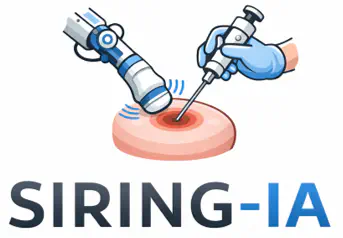
SIstema Robotico INtelligente e Guidato da IA per assistenza a mammografia e biopsia mammaria eco-guidata.
This is a research project funded by Fondazione VRT (Bando VRT 2026), in collaboration with the Breast and Radiology Units of the Azienda Sanitaria Universitaria Integrata del Trentino (ASUIT).
- 10-month project: February 2026-December 2026
- Interdisciplinary team bringing together robotics, AI for medical imaging, and clinical practice
- Pre-clinical validation on public/synthetic datasets and realistic phantoms (no patients involved)
Vision
SIRING-IA aims to develop and validate, at pre-clinical level, an intelligent robotic system that supports clinicians during mammography follow-up and ultrasound-guided breast biopsy. By integrating AI, collaborative robotics, and medical imaging, the system assists the clinician in localizing lesions and positioning the ultrasound probe during interventional procedures, improving accuracy and workflow efficiency while keeping the physician at the center of the process.
Challenges
Breast cancer is the most common cancer in women: about one woman in eight is affected during her lifetime, with more than 55,000 new diagnoses every year in Italy. Despite the effectiveness of mammography screening, its sensitivity is limited, especially in dense breasts, and recalls frequently require additional ultrasound examinations and ultrasound-guided biopsies. These procedures are strongly operator-dependent: the clinician must hold the probe with one hand while inserting the needle with the other, and repeated re-localization of the lesion is often needed to collect multiple samples.
Solution
Starting from the mammography, the system automatically localizes suspicious lesions. A robotic arm holding an ultrasound probe then autonomously positions itself to visualize, in real time, both the lesion and the needle, allowing the clinician to perform the biopsy with both hands. Unlike purely image-driven approaches, SIRING-IA enables an active exploration of the tissue that combines biomechanical models, force sensing, robotic palpation, and ultrasound feedback, making lesion localization robust even under poor visibility.
Expected outcomes include:
- higher accuracy and efficiency of tru-cut and vacuum-assisted (VABB) breast biopsies;
- collection of multiple samples without repeated lesion re-localization;
- immediate complementary ultrasound examinations in dense breasts, reducing recalls and patient anxiety;
- standardization of the ultrasound gesture and a shorter learning curve, opening to tele-medicine scenarios.
Team
- Robotics (University of Trento): Edoardo Lamon (Principal Investigator), Luca Beber (tissue physical models and safe control), Davide Nardi (teleoperation and human-robot interfaces), Antonella Rech (real-time visual anatomical models).
- AI and medical imaging: Selene Tomassini and Letizia Girardi (multimodal image analysis and fusion).
- Clinical team (ASUIT): Marvi Valentini, Anna Ventriglia, and Carlo C. Quattrocchi (clinical requirements, supervision, and validation).
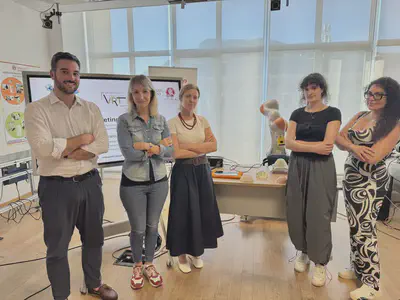

Edoardo Lamon
Assistant Professor (RTD-A) of Collaborative and Medical Robotics
Passionate researcher in human-robot interaction with applications to healthcare and manufacturing.


